
For reference only.
9e.0 Pseudo random sequence on 8-bit shift register and 'exclusive NOR'.

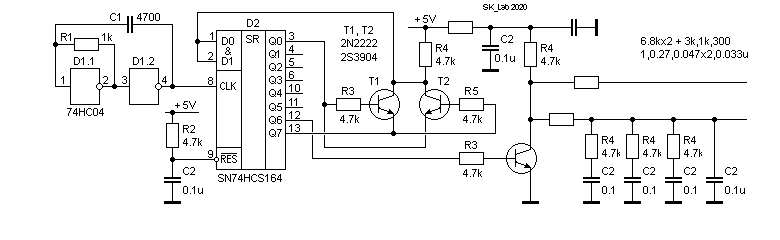
Parts of the circuits, from which, perhaps, a simple radar will be made.
9e.0 Pseudo random sequence on 8-bit shift register and 'exclusive NOR'.
This is a random number generator that has been known since school. Binary mathematics. The difference is that I didn't have a "Exclusive NOR" IC (74LS266) and had to replace it with two transistors. Idea taken from 'National Semiconductor Audio Handbook, 1977', page 4-37. More than an interesting source of ideas, and interesting to read.
The rest is even easier. The generator, based on TTL elements, produces pulses, the frequency of which is approximately equal to f = 0.5*(1/(R1*C1)). If capacitance in Farads and resistance in Ohms, then frequency in Hertz. These pulses, no matter what, move the bits at the outputs (Q0 to Q7) of shift register D2 (74hcs164). The 'Inverted Exclusive OR' (Exc.NOR), connected to Q0 & Q7, allows to do it more intricate.
As a result, 254 combinations appear at the output of the shift register, which are never repeated within 254 cycles. After, the cycle starts again, with "0000.0000" on Q0-Q7.
The only one combination on Q0-Q7, that is impossible in this case, is 1111.1111 (mathematically). In this case, the generator get stuck and the 1111.1111 will be always at the output. The reset chain, R2C2, allows to fix this at the very beginning.
* Such a "random" generator will work forever if, after 'Reset', there is at least one logical zero on any of Q0-Q7. *
Testing two simple TTL-based generators to find out how stable they are
Additionally, for a note: