This requires a precondition. This page was made only in gratitude to one person
who summarized many schematic diagrams of remote controls of RC-controlled toys.
I don't know who he is, but his work was enormous. My endless gratitude (thank's)
to him.Thank you, and thank's you again. Everything, in schematics, is academically correct.
This do not happen now, in real life. Pages like this disappear because people
get dumber. But, they will remain in this site archive. I hope, bc nothing permanent or so.
Whether you read this or not, thank you very much.
3.1.9 How this radio works and how to tune it'.
Simplified from a schematic diagram "super-regenerator" that here.
As we already know the super-regenerative RF circuit used in this type of receiver is able to achieve high levels of gain by repeatedly amplifying and regenerating the oscillator signal. This allows the receiver to detect and amplify weak RF signals, making it suitable for use in low-power applications. In the intervals when there is no RF signal, it makes a lot of noise, but this can be tolerated, given the simplicity of the circuit.
Here is schematic diagram, which is color-coded into several blocks that work independently of each other. If everything is already clear, then you can look at the waveforms and read no further.

In short, the "super-regenerator" (in black) is powered by a voltage regulator (in lilac). Through the low-pass filter (in red), the signal is fed to the audio amplifier (in yellow). RF interference's in & out are cut off by the filter (in green).
The following, from simple to complex.
1 Such radios are quite noisy in the RF range, so the use of a filter for the supply voltage (L4, C13, C14) is desirable.
2. In a parallel voltage regulator (R5, D1), a white LED is used as a Zener diode. The voltage drop across it within a small range depends on the current and is almost always in the range of 2.5-2.7 Volts.
3. The output of the "super-regenerator" is very noisy and contains tons of RF frequencies. The LF filter (L3,R4, C8, C9) cuts them off, and does not pass to the input of the amplifier. C11 protects the amplifier from self-excitation, which, if it happens, is hard to get rid of.
4. The "super-regenerator" all in black) is based on a transistor operating in "common base mode". It only means that it amplifies the voltage available at the emitter. This circuit does not amplify the current, but the voltage gain may exceed the gain of the transistor itself. This is what is being used.
5. The following is simplified.
A. The "super-regenerator", on transistor Q1, is a conventional oscillator that produces two frequencies.
The first is the self-extinguishing frequency (usually form 100 to 800 kHz), which has the shape of a saw and is constantly observed across the O2 resistor. It depends on RC constant of R2 & C7.
The second frequency (already in the RF range) is the one at which you receive the signal and is determined by L1, C5, and lesser by capacitor C6.
B. The capacitor C6, also, takes the signal from the antenna or collector of the transistor (as the output of the amplifier on Q1) and feeds it to the emitter Q1 (the input of the amplifier with a common base). This positive feedback only works at RF frequency and if the Q1 has sufficient gain.
C. We already know that there is a saw-tooth voltage at the emitter of the transistor. This leads to a change in the gain of the transistor from units to infinity (theoretically), each self-extinguishing cycle.
D. Sooner or later, the amplifier will capture the received RF signal (or if there is none, then just a noise) and amplify it. This will affect the frequency of self-extinguishing, and accordingly the total current consumed by Q1. We get it on the resistor R3 and send it (through a low pass filter) to the audio amplifier.
E. Because the "super-regenerator" is only sensitive to the amplitude of the RF signal, it will only accept AM (Amplitude Modulation).
Settings.
First you make sure that the voltages are similar to those shown in the diagram, and then you try to receive an RF signal. If you don't have an AM signal generator, you can make one using a similar schematic.
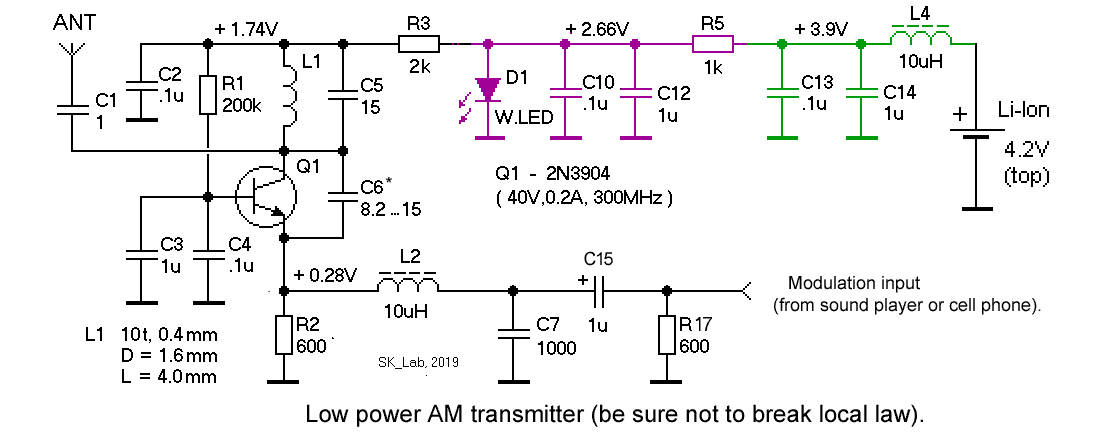
This should work, you only need to match the receive frequency in transmitter and receiver (the same for both). This is done by adjusting L1 or C5 first to frequency set up. Capacitor C6 tuned according to the best quality of the audio signal.
*** And if you have "something" to add or have questions, then my address below.