Simplicity is our goal. A little knowledge of
'C' language can always help, of course.
6.3.1 Pre story. 'C' language can always help, of course.
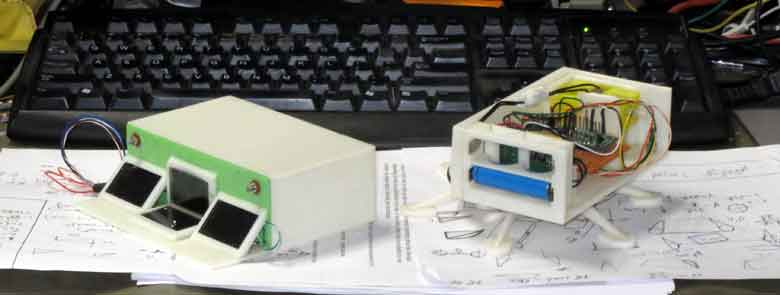
Actually, I made this particular solar device just to check whether two solar panels mounted at an angle of 90 degrees are more effective than one (two) same panel(s). This was an MIT (or so) study, and it seems to me that with the wrong result. This of course happens, and more often than you think. But there was an opportunity to verify this. The lack of time and the desire to check the result ASAP led to a simple 'solar tracker', which accompanies the sun along one axis.
6.3.2 The basis for a 'simple solar tracker'.
Actually, the sun is the most predictable. Earth makes a complete revolution in 24 hours, and almost half of this time we can see the sun above the horizon. A full revolution is 360 degrees, it takes 24 hours, which means that, for an observer from the Earth, the sun moves at an angular speed of 15 degrees per hour (0.25'/min., 0.0042'/sec., etc).
Actually, the sun is the most predictable. Earth makes a complete revolution in 24 hours, and almost half of this time we can see the sun above the horizon. A full revolution is 360 degrees, it takes 24 hours, which means that, for an observer from the Earth, the sun moves at an angular speed of 15 degrees per hour (0.25'/min., 0.0042'/sec., etc).
If we slow down the 'mechanical clock' by 2 times, then the hour arrow will always show the direction to the sun, even if "yellow dwarf" illuminates the opposite side of the planet. It makes sense, huh? That is why, if you have a usual mechanical watch and a direction to the sun, then you can determine were 'North', 'South', and so on. This is cool, but let's move on.
6.3.3 Simplified implementation of this idea.
Actually, a variable resistor, micro controller, & DC motor driver will do the job. A variable resistor (VR) is attached directly to a vertical axis of solar tracker. The voltage on VR is proportional to the angle or current position.
Actually, a variable resistor, micro controller, & DC motor driver will do the job. A variable resistor (VR) is attached directly to a vertical axis of solar tracker. The voltage on VR is proportional to the angle or current position.

All we have to do is start at east (in the morning), chase the sun during the day, and return to the east at the evening time.
* The real schematic diagram, and the rest, transferred to another page to shorten this.
6.3.4 And little more.
Since the solar tracker does not have any 'optical sensors', then it does not have an idea where the sun is. But, on the other hand, it definitely accompanies the sun throughout the day. How he does it?
The solution is that the sun, at noon, is always in the south direction. And the base, of the solar tracker, must be oriented south, the same. This is a prerequisite.

This corresponds to the middle position of variable resistor (which at the same time, is vertical shaft of device).

* Just let you know - the gearbox w/motor from "Dollar Store", body - 3D printed, driver - from old m/board.
6.3.5 Ready to setup and run.
To make the system run, you have to do three things, assuming that you will do it in daylight.
1. Orient the base to the south, and secure it.
2. Turn the body of solar tracker (w/solar panel or w/o) in the current direction of the sun.
3. And 'turn on' the power.
2. Turn the body of solar tracker (w/solar panel or w/o) in the current direction of the sun.
3. And 'turn on' the power.
What happens next is very simple. Immediately after turning on the power, the tracker will determine the current time by the position (value) of the variable resistor (or the sun position, if you want). And, from this moment on, it will turn itself 5 degrees every 20 minutes (3 times per hour). In the morning, the cycle will be repeated. System use 24h cycle.
6.3.6 If you want to make the same.
The only thing you should know that the enemy of such devices is the wind, to a greater extent than the weight of the solar panel. A wind load that tries (usually, and nonstop) to rotate the solar panel can quickly kill device. Therefore, there must be a soft connection from the gearbox, which allow the ability to slip. When the wind is strong, the panel will rotate without breaking the gearbox.
6.3.8 And for what it was done.
If you remember, the idea was to check whether two panels fixed at an angle of 90 degrees are more effective (as the study states) than the same 2 panels located separately.
The test was done on the configuration of the solar panels that you could see at the top of the page.
The following graph, with normalized (averaged) data, shows everything. The miracle, of course, did not happen. In short, two panels located independently will always win.

And, just because there is a solar tracker, several more experiments can be done. Namely, we check how the output power depends on the direction. The result coincides well with school geometry, as we expected.

Thinking about how to get more energy from existing panels, I have no better solution than using a conventional mirror. In my case, the sun was at an angle of 40 degrees to the horizon, and you can see the angle of the mirror on the graph.
The short result is that if you play with the angle of flat mirror, you can almost double the power generated by the solar panel. By common sense and without any interference from MIT's students, whose quality of education I began to doubt.
6.3.9 FYI.
You can further increase output power from the same solar cell if you concentrate sun light with an optical lens. Fresnel lens is a good solution, and solar trackers designed to make it real. Here everything will be limited by the temperature of the cell, which heats up very quickly. If you can, somehow, remove the heat (to use it separately), then you can get a wonderful result.
For example, the cell you saw in the photo (under normal conditions, sunlight, 1kW/sq.m), gives about 20mW. With lens, this power easily reaches 200mW. The only problem is that, under lens, the cell heats up to 300'C (600'F) in minutes. This is easy to observe, because conductors, that are soldered to the back, just fall off. Surprisingly, this overheat does not kill the thin-film cell.
The question remains how to remove heat and what to do with this heat after. Otherwise, it is very real.
Enjoy.
*** Any inaccuracies on this page will be corrected if you let me know (e-mail is highlighted next :) ***