
For reference only.
Two pulse generators for Geo Radar, comparison + my reminder.
9c.0 Second Schematic Diagram.
We are used to making stable generators, oscillator, etc. For geo-radar, the opposite is necessary. In it, the Type A oscillator works with a noise generator that produces a random phase shift. A funny story, the Type B generator does the same thing without the additional noise generator.

How generator "Type A" works has been shown here, so we will only focus on "Type B".
9c.1 The Type B generator on two inverters.
As before, the capacitor C2 is charged and discharged through the resistor R2, with the only difference that this resistor additionally transfers inverter D1.6 to a conventional amplifier mode. D1.4 is used as a buffer.
Oscillograms show, one after another, the input-output voltages on D1.6, D1.5, D1.4, D3.1 and on D3.1 more, and more accurately. Skip statistics. Waveforms will change every 5 seconds.
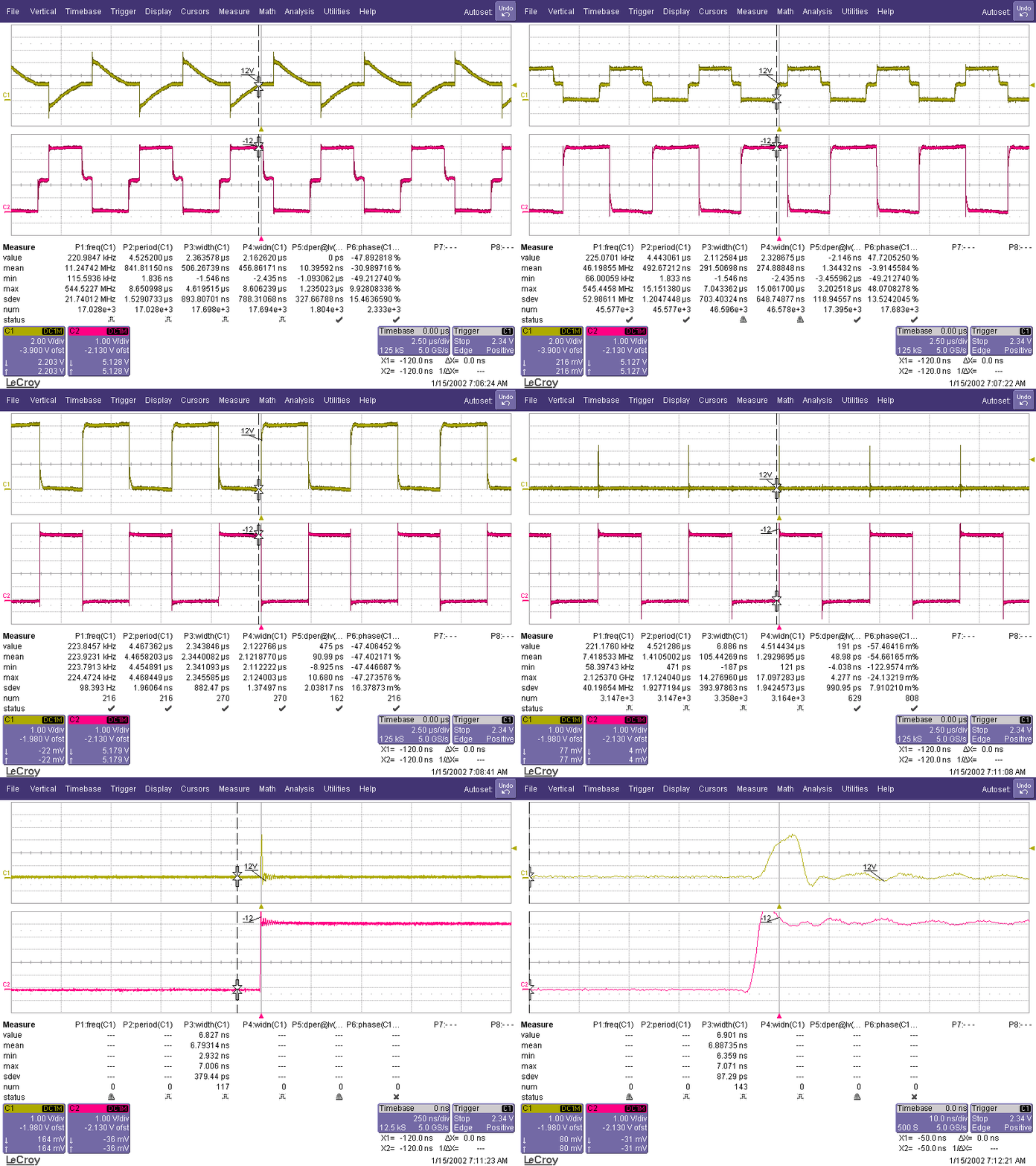
In general, this is exactly what you expected to see. But.
9с.2 Funny results that were hard to predict.
The simplest thing is that the frequency of both generators goes up with increasing temperature. After 80'C it can go up to 1 MHz (from 220kHz at 25'C). Part of the fault is with the capacitor, which reduces the capacity with temperature. In any case, this must be taken into account.
Phase jitter is present in both generators. Only in "Type A" it is not noticeable and amounts to fractions of a nanosecond. For "Type B" dozens of times more. Moreover, this increases (10 times at least) if two generators work simultaneously, under the hood of one IC.
Two generators working in one IC are synchronized in frequency. In this case, the "B" (was 230kHz) independently adjusts to the frequency of the more stable "A" (220kHz). The phase can be any, but the frequencies will be the same. After that, the phase jitter in "B" increases even more and reaches 60 nanoseconds (depending on the phase difference between both).
9c.3 The result for me.
At the moment, I think that injecting a small noise signal at the point where D1.6 and D1.5 connected, will make this jitter controllable. If the default jitter of 6nS is enough (most likely it will), then an additional noise generator will not be needed at all.
Actually, that's all :)
Additionally, for a note: