
For reference only.
Pulse generator (replacement for UWB Geo Radar) + my reminder.
9d.0 Final schematic.
The fact that the oscillator on two inverters has proven to be dramatically unstable works in a good direction for us. It replaces the classic stable generator (on 3 inverters), into which a noise signal had to be injected from a side (so that each next impulse to antenna comes randomly in time).
Therefore, everything is simplified even more. As before, the capacitor C1 + C2 is charged and discharged through the resistor R1. D1.1 and D1.2 make this possible. D1.3 is a buffer. The rising edge on C1 D2.1 is set the trigger, which is immediately reset. Exactly the same happens on the second flip-flop, with the difference that the rising edge comes with a delay via VR1 and C3.
As before, everything you want to know is on the schematic.

* In order to prevent the frequency shift from temperature (at 60'C it can double) instead of one capacitor there are 2. One increases the capacity with temperature, the second lowers.
A fun with an oscilloscope, again.
9d.1 Outputs from triggers.
If you connect the scope to the inverted output of any trigger (pin 6, D2.1, for example), the picture will look like the following.
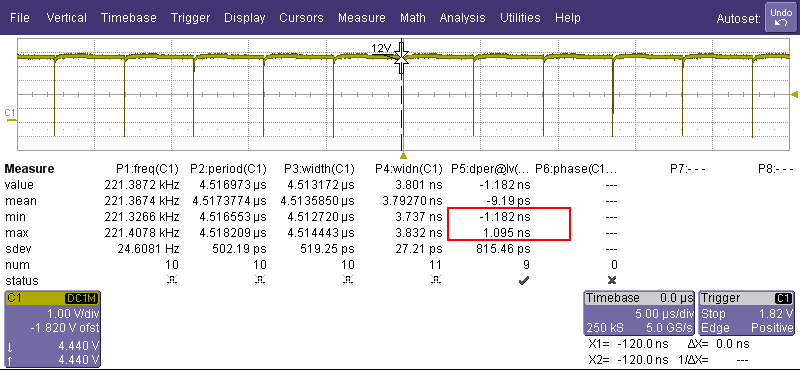
The first diagram, which is done on single shot. Phase jitter (about 0.77nS) is highlighted with a red window.

The same thing, only after a few seconds (it was necessary to wait for statistics to accumulate). Within one minute it will become from 3 to 4nS. Each next pulse may come earlier or later, which is not predictable. Gaussian distribution, right?
And lastly, we always want to see what this pulse looks like. Click on the image to open it in more detail.

Nano pulses from such a simple device!? Who would have expected this?
9d.2 Pulse stay too long for yours application?
If so, then this is not the end of the world. The trigger is already gives us the shortest possible pulse. Using a faster trigger is the simplest solution. But it is not one. The classic solution is to reshape the pulse with help of transmission line, or stub. Coax cable will work great.
All you need to know is that if you send a pulse into an open-ended coax cable, it will travel to the end and back, and return in phase with the initial pulse. For a cable shorted at the end, everything is the same, only it will return pulse in anti-phase. The delay, between "sent" and "returned" pulses, will depend on the length of the cable (coaxial or so).
You just have to set up the correct cable length.
Actually, that's all :)
Additionally, for a note: